
Canwick Storm Tank Capacity Increase
Canwick Water Recycling Centre (WRC), located to the south-east of Lincoln, serves a significant proportion of the city and surrounding communities. It treats wastewater from both residential and commercial sources before safely returning it to the environment. As part of Anglian Water’s wider network, the site plays a key role in supporting a complex and […]
Aug 5, 2026
Canwick Water Recycling Centre (WRC), located to the south-east of Lincoln, serves a significant proportion of the city and surrounding communities. It treats wastewater from both residential and commercial sources before safely returning it to the environment. As part of Anglian Water’s wider network, the site plays a key role in supporting a complex and interconnected system of assets that must operate reliably under varying hydraulic conditions.
The Canwick catchment is subject to increasing regulatory scrutiny around storm overflows and environmental performance. Updated requirements introduced through PR24 place greater emphasis on storm storage capacity, settlement performance and the reduction of intermittent discharges to receiving watercourses.
In response, Anglian Water’s @one Alliance was tasked with designing and delivering a £3.3 million scheme to increase storm storage capacity at the site, ensuring compliance while improving operational resilience and enabling future network integration.
Background
Canwick WRC operates within a well-established site that has evolved over time to meet the needs of the communities it serves. It includes a range of treatment assets such as storm tanks, grit chambers and return systems, all working together as part of a wider integrated network. The site is also closely linked with upstream assets, including Washingborough WRC, which supports a coordinated approach to managing flows and optimising performance across the catchment.
The surrounding area includes agricultural land and environmentally sensitive watercourses, meaning that protecting the local environment remains a key priority. Careful consideration is being given throughout the design and construction process to maintaining high effluent quality and minimising storm discharges.
Together, these factors required a solution that is compliant, resilient and adaptable, while being delivered safely within a live operational site and supporting the long-term needs of customers and the environment.
The Issue
The primary challenge at Canwick WRC was to increase storm storage capacity in line with updated regulatory requirements. After hydraulic assessments had taken place, it had identified that a total capacity of 9,173m³ was required, compared to the existing 5,597m³, resulting in a shortfall of 3,576m³. And addressing this gap was important to ensure the site can continue to effectively manage peak flows, maintain high standards of effluent quality and meet Environment Agency expectations, while also supporting the wider network, particularly the planned integration with Washingborough.
The scheme also needed to be delivered early in AMP8, to align with broader network improvements. This was carefully managed within a live operational environment, where space is limited and existing infrastructure is already in place. The solution therefore needed to be practical and efficient to construct, while ensuring continuous treatment operations were maintained throughout, minimising disruption and continuing to provide a reliable service for customers and the environment.
The Solution
The solution for Canwick WRC was developed through detailed planning and design, ensuring that the additional storm storage could be integrated effectively within the existing site while maintaining operational performance and minimising disruption. The initial concept, identified the need for a new storm tank to provide the required increase in capacity. This was further refined through detailed hydraulic modelling, using existing asset data such as invert levels, weir settings and system interactions, to ensure the new infrastructure would operate seamlessly alongside the current storm storage system.
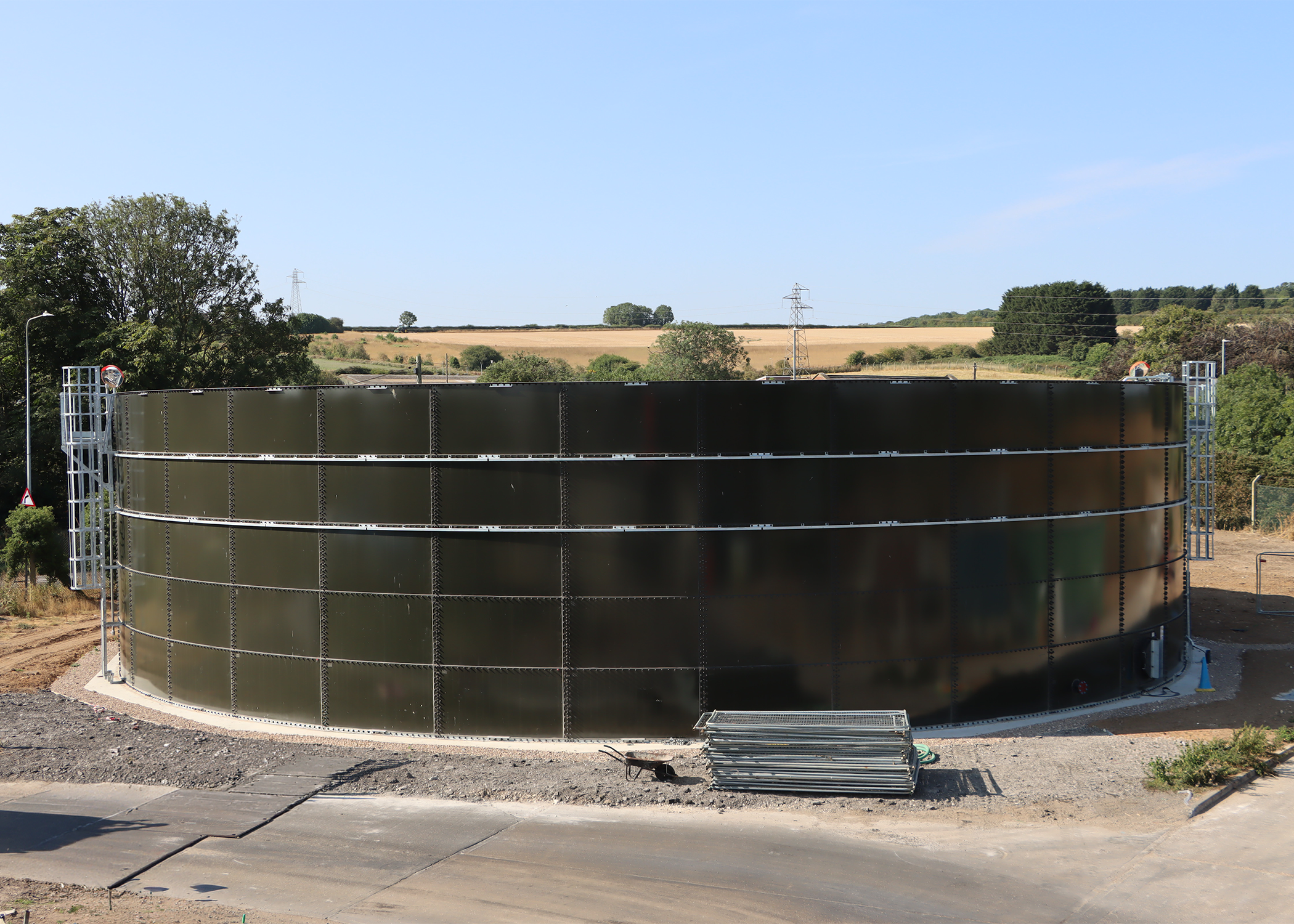
A key aspect of the design was the adoption of a glass-coated steel storm tank, providing a modular and space-efficient alternative to traditional in-situ concrete construction. This approach enabled the required capacity to be delivered within the site’s constrained footprint while reducing construction complexity and programme duration. The design allows the new and existing storm tanks to operate in parallel, using level control instrumentation and three feed pumps to enable coordinated, simultaneous filling. A gravity return system was incorporated to discharge flows back into the treatment process via an actuated valve and a newly constructed valve chamber, connecting into the existing return chamber (MH1). This arrangement improves operational reliability by reducing reliance on mechanical systems while maintaining controlled and efficient flow management.
The new storm storage asset has a diameter of 28.178m, a height of 7.035m and provides a working volume of 3,600m³, increasing the total site capacity to 9,173m³ and meeting regulatory requirements. Supporting mechanical and electrical systems include ultrasonic level monitoring, local control panels integrated into the existing kiosk, and provision for telemetry and future MCC/SCADA integration. An automated cleaning system, using a CWF flushing bell with manual siphon air release, has also been incorporated to reduce maintenance requirements and improve operational efficiency.
Constructability was a key consideration throughout, with the design tailored to suit the constraints of a live operational site. A hybrid construction approach was adopted, combining efficient installation methods with practical solutions to avoid existing infrastructure. This included the installation of feed pipework supported on gravel with directional supports, the construction of a pipe bridge over the existing grit chamber to avoid complex underground services, and the development of new civil infrastructure such as a pump station chamber, valve chamber and associated slabs. Cable routing was carefully planned to integrate with existing systems, ensuring continuity of control and monitoring.
The use of a prefabricated, modular tank reduced on-site construction time and improved quality control, while construction activities were carefully phased and sequenced to maintain continuous treatment operations. Controlled tie-ins and planned installation works ensured that the WRC remained fully operational throughout delivery, providing a practical, resilient and future-ready solution that meets both regulatory and operational requirements.
Supply Chain
The successful delivery of the Canwick scheme has relied on a collaborative, multi-disciplinary approach between many key suppliers:
- AVK – Valves
- Barhale – Principal Contractor
- Eliquo Hydrok – Flushing Bell Partner
- Endeavour Drilling – Coring Subcontractor
- Gorman-Rupp – Pump Supplier
- Hayes – Storage Tank Supplier
- Kamada – Generic EICA & Mechanical Partner
- Principal Contractor - Barhale
- Pulsar – Instrument Supplier
- Saint-Gobain / Wolseley – Pipe & Fittings Suppliers / Fabricators
- TES – MCC Partner
- Tubes – Scaffolding
- Waveneys – Pump Skid Fabricator
- Xylem – Pump Supplier
Benefits of this project
Environmental and operational considerations have been central to the design and delivery of the Canwick scheme. From an environmental perspective, the increased storm storage capacity significantly reduces both the frequency and impact of storm overflow events, helping to improve settlement performance and reduce pollutant loads entering receiving watercourses. This in turn supports improved effluent quality and contributes to the protection and long-term health of downstream ecosystems. The adoption of an above-ground, modular storm tank solution has also helped to reduce construction-related carbon impacts by minimising excavation requirements and significantly reducing the volume of concrete used. Alongside this, shorter construction durations and more efficient use of materials have further contributed to lowering the scheme’s overall carbon footprint. In addition, the enhanced system reduces the risk of uncontrolled discharges during periods of extreme weather, strengthening environmental compliance and improving resilience for the future.
From an operational standpoint, the scheme delivers a substantial uplift in hydraulic capacity, enabling the site to better manage peak flows and maintain stable performance under a wide range of operating conditions. By integrating the new storage tank with the existing infrastructure, the system now benefits from improved redundancy and greater operational flexibility, with parallel tank operation allowing flows to be distributed more efficiently and reducing pressure on individual assets. The introduction of automated cleaning systems and modern instrumentation also reduces day-to-day maintenance requirements while improving overall operational efficiency. Real-time monitoring capabilities further support proactive asset management and more informed operational decision-making. Importantly, the scheme also enables the progression of the Washingborough transfer, helping to unlock wider network optimisation and supporting future growth and resilience across the wider catchment.
Conclusion
The Canwick Storm Tank capacity increase scheme demonstrates how targeted infrastructure investment can address regulatory requirements while delivering wider operational and environmental benefits. And at the time of writing, the project is nearing completion, with final commissioning and close-out activities currently underway.
By increasing storm storage capacity to meet PR24 requirements, the scheme ensures compliance with Environment Agency standards and significantly improves the site’s ability to manage peak hydraulic events.
The project has been delivered within a constrained operational environment, using a modular and efficient design approach that minimises disruption and reduces carbon impact. At the same time, it enhances resilience, redundancy, and long-term asset performance.
The successful integration with upstream assets, particularly the Washingborough scheme, highlights the importance of coordinated, system-wide planning.
Overall, the scheme provides a robust, future-ready solution that supports environmental protection, operational continuity, and sustainable growth, offering a strong example of best practice in storm management across the water industry.
Sponsored Advert

Related Posts

Developer shows support for St Austell school
Cornwall’s biggest housebuilder has donated £2,000 to supporters of a special school near St Austell. The donation from Persimmon Homes to Friends of Doubletrees School in St Blazey comes from the developer’s Community Champions programme that sees £700,000 donated to...

City Centre South reaches major milestone as first tower begins to rise
A major milestone has been reached at Coventry's transformational City Centre South regeneration project developed by The Hill Group, with the first tower now rising from the ground following the completion of demolition and extensive groundworks across the site....

New Forest District Council’s strategy puts prevention at the heart of tackling homelessness in the district
New Forest District Council (NFDC) has launched a strategy to prevent homelessness, support people at risk, and help residents find secure accommodation. The Homelessness and Rough Sleeping Strategy sets out NFDC’s priorities for tackling homelessness and...