
Design & Build UK 14.9 feature – The Digital Transformation: AI’s role in delivering new homes
The planning system has frequently been criticised in recent years for being out-of-date, complex, subjective and slow. With the highly anticipated response to the Planning for the Future White Paper from the Government, the new updates to the National Planning Policy Framework (NPPF) and National Model Design Code, significant change is coming. One area which […]
Oct 4, 2021
The planning system has frequently been criticised in recent years for being out-of-date, complex, subjective and slow. With the highly anticipated response to the Planning for the Future White Paper from the Government, the new updates to the National Planning Policy Framework (NPPF) and National Model Design Code, significant change is coming. One area which is frequently discussed is how digitalisation can improve the planning system. From increasing community engagement and facilitating communication, to better access to data and better understanding of local areas with 3D-models or digital twins, technology can help the process become more efficient, inclusive and fair.
One key area where PropTech or PlanTech tools have the ability to really improve the planning system is by supporting decision making on an individual site, as well as at a neighbourhood or city scale. The power of computers and digital technology enables much more data to be captured and analysed all in one place and at a much faster pace. It is this power which should be leveraged to make it easier to deliver value for developers and local authorities alongside better places for local communities.
With the increasing number of regulations and higher standard and ambitions that need to be met, particularly around quality, social value and sustainability, it is becoming more challenging to navigate through the hoops required to deliver new homes. This is not just a challenge for those submitting planning applications but also those who need to review these proposals.
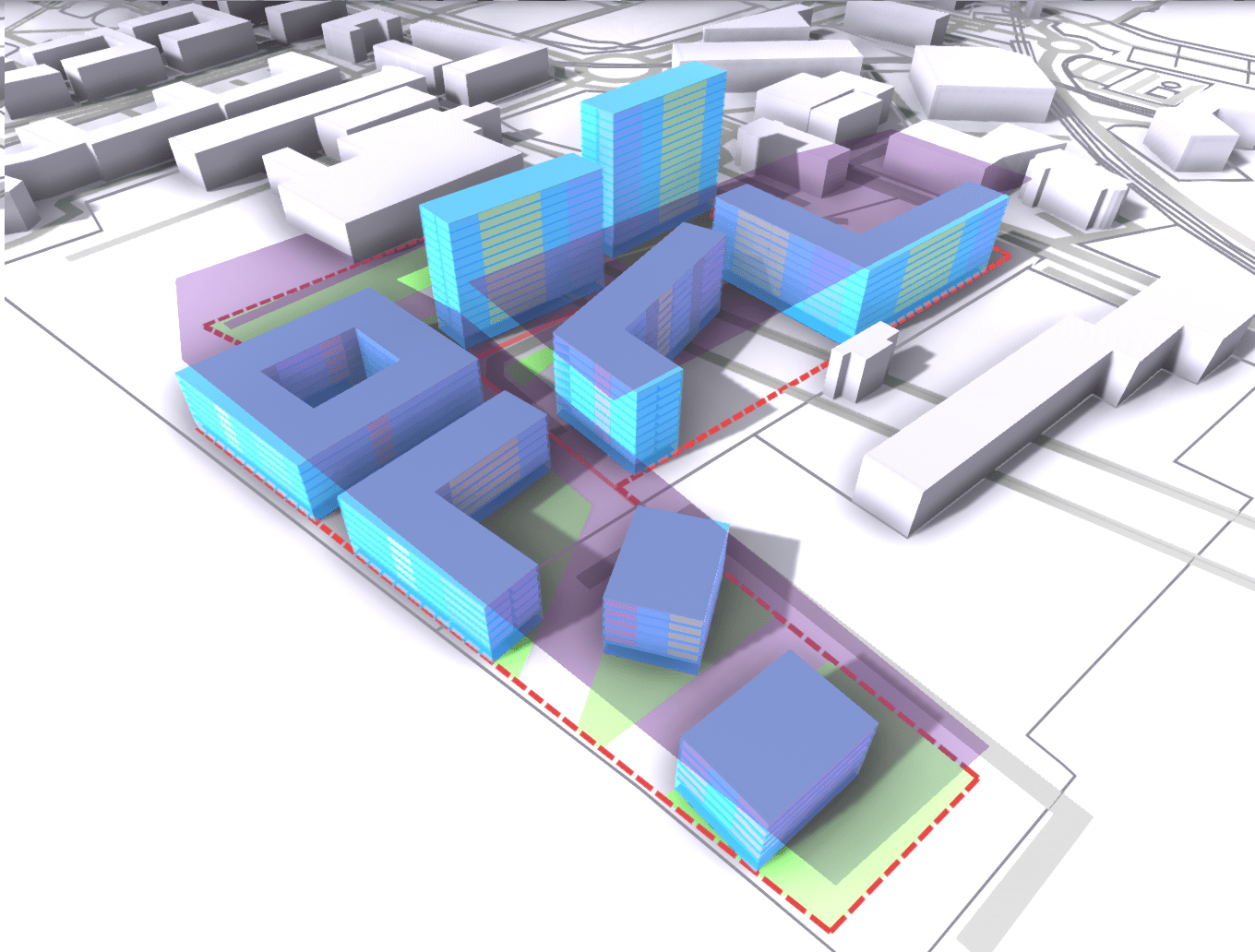
Tools that are built on algorithmic rule sets, such as SiteSolve (Ramboll’s generative design tool), could be used to give greater confidence that every solution created meets the quantifiable aspects of design. In addition to this, such tools enable ideas to be rapidly appraised for multiple criteria- from quality objectives to energy usage to economic success. The use of computational power means more options and ideas can be explored and optimised to help design teams find solutions that meet their drivers. If these tools can be used to support the planning process in a more standardised way, it could provide local authorities with a much easier, simpler process to evaluate proposals, and help design teams efficiently develop solutions focused on the qualitative aspects.
No individual site is designed in isolation, but is part of a larger urban fabric and network of infrastructure services. This is another area where digitalisation and data can provide a greater understanding of a larger area, portfolio, or system, to help drive better holistic strategy decisions. For example, SiteSolve supported Transport for London in evaluating 2000+ plots of land associated with transport infrastructure that could be released for development. This showcased how digitalisation can help to identify where investment should be prioritised by providing a greater understanding of the risks or opportunities across a portfolio. The application of technology like this can help the planning system to test and develop local plans or deliver larger ambitions, such as 20-minute neighbourhoods.
There are many digital tools and data sources appearing throughout the industry, with various areas of expertise or tackling a different aspect of the planning process. For these innovations to be truly leveraged, the ability to bring them together is crucial. Standardisation of data formats and interfaces between different platforms or tools will enable more data to be easily brought together to allow decisions to be made on holistic information. The TfL study, for example, brought together the expertise of multiple parties through technology by agreeing a standardised data sharing approach. This included planning constraints, cost and value data, economic growth assumptions and engineering design rules, all in one place. This resulted in conclusions that would not have been extrapolated by any party individually.
Digitalisation has the ability to improve the planning system across the UK, but it requires widespread adoption and collaboration to really leverage the greatest benefits. The Government will need to encourage technology adoption throughout the public sector to showcase the benefits to the private sector, through schemes such as the Ministry for Housing, Communities & Local Governments local pathfinder programme. If technology and digitalisation can be used to improve the planning process, it could really help to unlock the delivery of new homes in a way that maximise economic, social and environmental value.

Emily Scoones, Business Development Lead, SiteSolve
For more exclusive features like this in and around the construction industry, consider subscribing to the Design & Build UK magazine for just £2 a month!
Related Posts

RICS partners with Retrofit Academy to accelerate retrofit skills with funded training
The Royal Institution of Chartered Surveyors (RICS), and The Retrofit Academy (TRA), are partnering to help RICS members develop critical retrofit skills across the UK. At the heart of the partnership is access to UK Government-backed Warm Homes Skills funding,...

Dudleys Consulting Engineers Completes on 40,000 Square Feet M1 Business Park
Dudleys Consulting Engineers have completed works to deliver a major new 40,000 sq ft industrial development at Calder Park in Wakefield. The £3.5 million scheme by Marrtree Investments now offers nine high specification trade counter units ranging from approximately...

Planning approval granted for new nature park at Royal Liverpool Hospital
A major milestone has been reached in the future of patient and community wellbeing in Liverpool, as planning permission has been granted by Liverpool City Council for a landmark project that will create a nature-rich public garden on the former Royal Liverpool...