
TfL reminds Londoners of important changes to buses when schools start to return next week
Like other Londoners, all children and young people aged 11 or over must wear face coverings on whichever service they use unless they are exemptMore than 220 high-frequency routes that serve schools will have designated “School Services” before and after schoolMore than 230 extra buses will be added to ensure school pupils can get to […]

Aug 27, 2020
- Like other Londoners, all children and young people aged 11 or over must wear face coverings on whichever service they use unless they are exempt
- More than 220 high-frequency routes that serve schools will have designated “School Services” before and after school
- More than 230 extra buses will be added to ensure school pupils can get to and from school and that other Londoners get around whilst social distancing
- On some routes around half the buses will be School Services at peak school times
- Parents, students and school staff are encouraged to walk, cycle or scoot whenever they can, while those not travelling to school are advised to travel at quiet times where possible.
Transport for London (TfL) is today reminding Londoners of important changes being made to the bus network that will make it easier for children, young people and teachers to travel safely on public transport as schools start to return from next week.
The changes, which will see large parts of the bus network operate differently than before, will also help to accommodate the journeys of the growing number of people returning to their workplaces across London as national pandemic restrictions are gradually eased.
Pre-pandemic, around 250,000 school children used London’s buses daily to get to and from school and, to ensure that they can safely return, TfL is asking schools and parents to encourage walking, cycling or scooting to travel to school wherever possible, with an extensive communications campaign having been launched to encourage people to do so.
More walking, cycling and scooting to school will reduce the pressure on buses and the road network, but additional measures are also needed, and TfL is introducing a range of important changes to meet and manage demand.
From Tuesday 1 September, TfL will:
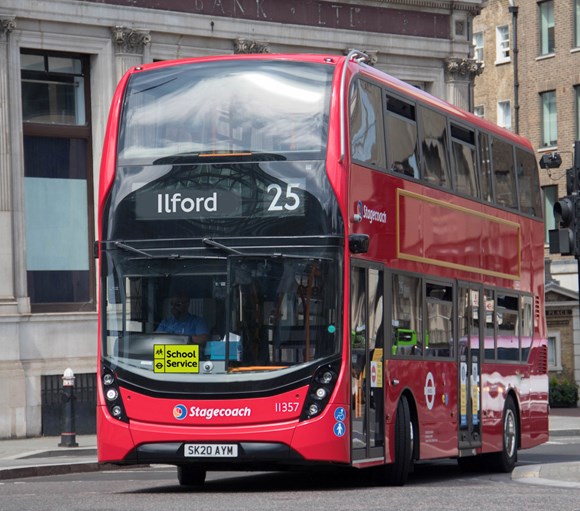
- Designate some existing regular buses as School Services on high frequency routes, which are prioritised for school travel and can operate at full seated capacity consistent with Government guidelines;
- Add more than 230 extra buses as School Services to bolster some of the busiest lower frequency routes that are highly used by schoolchildren, including adding more vehicles to its existing school bus services.
This means that on some routes that serve schools, around half of buses will be designated as a School Service during school travel times. All buses designated for school travel will carry prominent “School Service” signs to clearly indicate that people not travelling to school should not use them. Other buses on those routes with some school services and some non-school services, will have red signs to differentiate them from School Services and show schoolchildren to avoid boarding them. Information will also be available online and will be posted at relevant bus stops in the biggest bus stop poster campaign in TfL’s history.
Schoolchildren travelling without adults are encouraged to travel on School Services where they are provided in order to make space for other customers on regular services. Anyone else needing to travel at these times should board regular non-school buses as usual.
To cope with the likely increase in demand for buses, as students, teachers and other school staff return, these changes are planned to help across London on weekdays between 07:30-09:30 and 14:30-16:30.
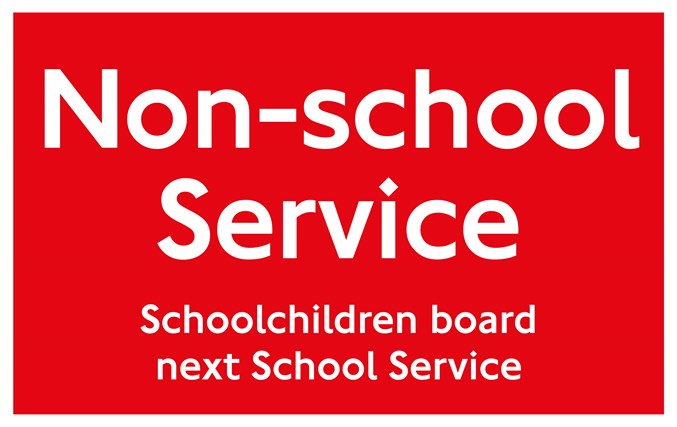
Government guidance allows for the relaxation of social distancing requirements on dedicated School Services. Based on a risk assessment of school travel and the use of face coverings, TfL is able to increase the capacity of these buses to allow all available seats to be occupied on dedicated School Services. This will mean that the bus network can carry more children to school while still freeing space on non-school buses for other customers. This is particularly important as capacity limits remain in place on regular services and more and more people start to return to their workplaces after the summer break. All of these measures are supported by an extensive cleaning regime across London’s transport network, including the use of hospital-grade long-lasting disinfectant to ensure that transport services are cleaner than they have ever been. They are also supported by TfL staff and police partners who are out across the network helping customers and reminding them of the rules on face coverings that are there for the safety of everyone travelling.
Customers aged 11 or over are required to wear a face covering when using public transport services (including non-School Services) or stations, or taxi and private hire services, unless they are exempt. TfL advises anyone exempt from wearing a face covering to carry an exemption card, with further details being available on TfL’s website. People should also carry hand sanitiser and wash their hands before and after they travel.
Those who may not have used the transport network for some time and those returning to work may find some differences to the transport network, but planning journeys in advance and allowing more time for journeys during school travel times, coupled with TfL’s capacity and frequency increases, will mean that many more people can have safe and hassle-free journeys. Those who are unable to travel outside the busier times may need to wait slightly longer to board a bus, but TfL will monitor locations across London to address any issues at specific locations.
TfL has engaged with more than 3,000 schools to encourage active travel and advise on staggering start and end times, with bespoke plans for those schools served by the busiest bus routes for school travel. There is also advice and useful resources for schools to encourage safe and sustainable travel on a new dedicated TfL webpage. There is also a new STARS Safer Journey Planner to help students and parents/carers plan their journeys and provide useful advice on walking, cycling and scooting to school safely.
There will be no changes to fares and ticketing for children in September and a start date for the temporary suspension of under-18 free travel requested by the Government in the funding agreement between them and TfL has not yet been confirmed.
TfL’s trial of 24-hour bus lanes on its own roads, due to start in the coming weeks, will support changing travel patterns and staggered school hours, helping to maximise capacity and support social distancing, keep bus journey times consistent throughout the day, and reduce crowding at bus stops.
Gareth Powell, TfL’s Managing Director of Surface Transport, said: “We are doing everything we can to get children and young people back to school as well as supporting their teachers and other school staff and people returning to their workplaces after the summer break. Changes on this scale have never been made to the bus network before and we need everyone to do their bit to ensure children can safely return to school. It will greatly help if people can travel outside the peaks or walk, cycle or scoot wherever they can.
“Our transport network is the cleanest it has ever been, with extensive and frequent cleaning taking place, and our staff and police colleagues are out across the network to help and to ensure everyone understands the rules on face coverings.
“September is always a challenge on the bus network and, given the circumstances, customers may need to wait a bit longer to board buses. but with these new measures and the extra buses we are providing, and with everyone playing their part, we can ensure that everyone can reliably and safely get where they need to be, and London can continue to recover from the pandemic.”
The measures support London’s safe and sustainable recovery from the pandemic, including greater use of walking and cycling. Those who are able to walk, cycle or scoot to school are being encouraged to do so, with TfL’s world-leading Streetspace programme making this easier and safer than ever before.
More than £3m has been invested to date in 415 School Street schemes, across 26 boroughs, making active journeys to school safer and easier by limiting car access to school gates at drop off and pick-up times. Some 22 School Street schemes have been delivered through the Streetspace programme so far, with many more due for completion in the coming weeks.
Funding coming as part of an additional £5.8m grant from the Department for Education will facilitate these changes and it is the first time London’s bus network has been altered on this scale, working with schools, London boroughs and Government.
Sponsored Advert

Related Posts
Developer shows support for St Austell school
Cornwall’s biggest housebuilder has donated £2,000 to supporters of a special school near St Austell. The donation from Persimmon Homes to Friends of Doubletrees School in St Blazey comes from the developer’s Community Champions programme that sees £700,000 donated to...

City Centre South reaches major milestone as first tower begins to rise
A major milestone has been reached at Coventry's transformational City Centre South regeneration project developed by The Hill Group, with the first tower now rising from the ground following the completion of demolition and extensive groundworks across the site....
New Forest District Council’s strategy puts prevention at the heart of tackling homelessness in the district
New Forest District Council (NFDC) has launched a strategy to prevent homelessness, support people at risk, and help residents find secure accommodation. The Homelessness and Rough Sleeping Strategy sets out NFDC’s priorities for tackling homelessness and...