
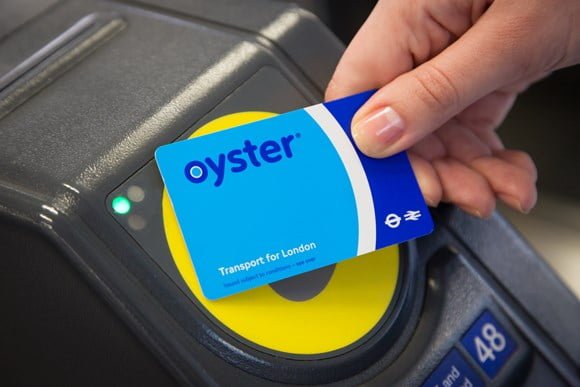
Fifteen years of more convenient travel thanks to the Oyster card
Public transport smartcard launched on 30 June 2003 - revolutionising the way transport is paid for in the capital Sophisticated system has enabled daily capping and the Mayor’s Hopper fare - making travel more affordable for Londoners Since it launched, the system has expanded to cover more than 650 Tube and rail stations across London […]
Jul 4, 2018
- Public transport smartcard launched on 30 June 2003 – revolutionising the way transport is paid for in the capital
- Sophisticated system has enabled daily capping and the Mayor’s Hopper fare – making travel more affordable for Londoners
- Since it launched, the system has expanded to cover more than 650 Tube and rail stations across London and the south east, as well as all London buses, trams, Emirates Air Line and Thames Clippers River Bus services
- Smartcard system led the way for development of ticketing using contactless bank cards, which is now being adopted in New York, Brisbane, Boston and Sydney
More than 100 million people from around the world have benefited from more convenient travel in London in the last fifteen years thanks to Transport for London’s (TfL’s) Oyster card.
Launched 15 years ago tomorrow, on 30 June 2003, the world-famous transport smartcard has transformed the way customers pay for travel across the city. By replacing paper tickets with pay as you go on a smartcard, customers benefit from having more flexibility when they travel and only pay for journeys they actually take. The system also caps the total cost of journeys meaning you never pay more than the equivalent daily travel card and offers greater protection in case customers’ tickets get damaged or lost.
Oyster has also enabled the Mayor’s Hopper fare, which makes travel more affordable for Londoners by letting customers make unlimited journeys on London’s buses and trams within an hour for the price of one.
Historically, London has led the way globally in developing transport ticketing technology. Magnetic-stripe tickets were first introduced on the District line in London in the 1960s and the first trials of smartcard technology, which would lead to Oyster, began as early as 1992. The success of the Oyster card in dramatically cutting queues to purchase tickets, and having fares capped to provide the cheapest fares, led TfL towards the wider development of ticketing using contactless bank cards. Since it first launched on buses in December 2012, this world-leading way of paying for travel has grown to now account for more than half of all pay as you go journeys in London. In total, more than 90 per cent of all Tube, bus and rail journeys in London are now made using smartcards instead of paper tickets.
The success of paying for travel using contactless bank cards in London is now leading to more world cities introducing the technology as a convenient method of paying for travel, with New York, Brisbane and Boston all recently announcing plans to introduce it in the coming years.
Heidi Alexander, Deputy Mayor for Transport, said: “Since its launch 15 years ago the Oyster Card has transformed travel in London – not only stopping people having to queue in long lines for paper tickets, but allowing regular passengers to benefit from cheaper travel, with daily capping, and the introduction of our ‘Hopper’ Bus fare, which has cut the cost of millions of bus journeys.
“I’m delighted that from December next year, Oyster Card will also be extended further outside London when the Elizabeth line opens to Reading. Whether it’s the Oyster Card or the development of contactless around the world, TfL continues to be a world leader in using the latest technology to improve the experience of everyone using our public transport network.”
Shashi Verma, Chief Technology Officer at TfL said: “The Oyster card is an essential part of London and we’re delighted with how popular this innovation has become in the last fifteen years. It has transformed travel on public transport in London, become a world-recognised product and helped provide more affordable and convenient travel for everyone.
“Along with the planned expansion along the entire Elizabeth line from December 2019, we are continuing to develop and improve the system so that even more customers across London and the south east will benefit in the future.”
Dave Roat, Strategy Manager, Cubic Transportation Systems, said: “The introduction of the Oyster Card in 2003 revolutionised the way people pay and travel around London, saving customers time and money. Initially designed as an innovative method of fare validation and to reduce paper wastage, it has continually evolved to meet people’s needs and has become an essential part of any Londoner’s wallet.
“It has paved the way for new payment methods and ticketing technologies such as contactless bank cards, NFC enabled mobile phone payments and top up apps. Following the success of the Oyster Card, cities around the globe have sought TfL and Cubic’s help to develop similar solutions for their transport networks. Today, cities such as New York, Boston and Brisbane are using TfL’s intellectual property and enabling their commuters to experience contactless technology, and its benefits, in the same way Londoners have over the last 15 years.”
Since it launched, London’s pay as you go ticketing system has evolved to respond to customers’ needs. In January 2010, the Oyster system was expanded to cover all commuter rail services within Greater London, allowing anyone to travel easily by just using one card. Since then, it has continued to grow and now covers services to Gatwick Airport, Hertford East, Swanley and Dartford. From December 2019, the system will also be extended out to Reading as part of the Elizabeth line.
TfL has also worked to make travel more convenient for Oyster customers. As well as the Mayor’s Hopper fare, TfL has improved the Oyster Online system and launched the official TfL Oyster and Contactless app. This allows customers to top-up or purchase season tickets and Bus and Tram Passes on the go. Once purchased, they can then collect their products by simply touching onto a reader after 30 minutes as part of their journey.
Later this year TfL will also be introducing ‘Monday to Sunday’ weekly capping to the Oyster card. This major upgrade will mean that customers who regularly travel using an Oyster card will see their travel capped at the equivalent of a weekly travel card.
For more information about the Oyster card, please visit www.tfl.gov.uk/oyster
Related Posts

Acorn Analytical Services Appoints First Female Directors
Leading asbestos management consultancy, Acorn Analytical Services, has announced the appointment of two new directors - the first female directors in the company’s history. Sian Stone and Viviana Pista have been promoted to Associate Directors in recognition of their...

Building a More Inclusive Industry
Design & Build UK is proud to support the launch of a new Equality, Diversity and Inclusion in Construction online assured course, developed in collaboration with NOCN Group and Women in Construction. This initiative reflects a shared commitment to strengthening...

Shakespeare Martineau advises on landmark Barratt Redrow joint venture for 8,500 home garden town scheme
National law firm Shakespeare Martineau has advised Barratt Redrow on a major joint venture with Places for People to deliver one of the UK’s most ambitious new community developments. The scheme will create a pioneering garden town-style development in East...