
Automation crucial to increase UK productivity levels
Supply chain specialists, Balloon One, have conducted some new research looking into why the UK is lagging behind in its use of industrial robots, and how its national productivity is suffering as a result. Compared to nations with a similar manufacturing output, the UK is using fewer robots in industry and aren't able to achieve the same […]
Feb 3, 2021
Supply chain specialists, Balloon One, have conducted some new research looking into why the UK is lagging behind in its use of industrial robots, and how its national productivity is suffering as a result.
Compared to nations with a similar manufacturing output, the UK is using fewer robots in industry and aren't able to achieve the same productivity levels.
To gain this insight, Balloon One looked at:
- The top countries for robot density (number of industrial robots per 10,000 workers)
- Productivity (GDP per hours worked)
- Each country's reliance on manufacturing (value added, percentage of GDP)
To see if there really was a link between having a greater robot density and having a more productive industry, they looked at data from the nations with the most robots from across the globe to see how productive they were and how much they relied on manufacturing as a percentage of their GDP.
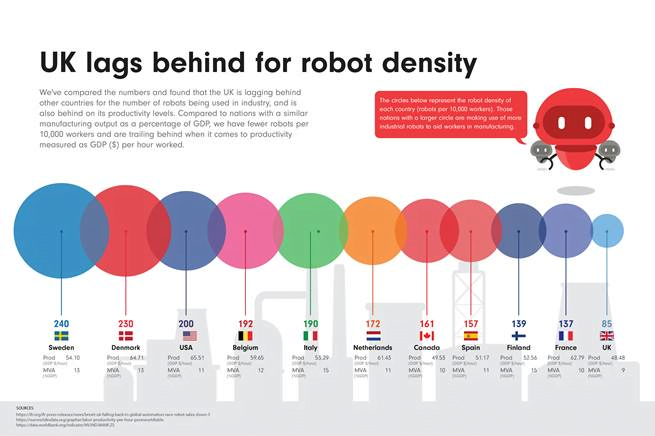
The graphic above shows the UK compared to ten other nations that have similar levels of manufacturing. Not only are we using fewer robots, but we are lagging behind in terms of our productivity levels, arguably as a result of having lower levels of automation.
Ultimately the UK is ranked 20th most productive country in the world:
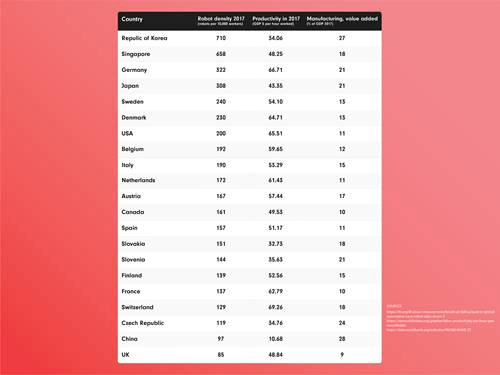
Balloon One found that:
- For the countries with a robot density of 200 and above, the average productivity is GDP $53.81 per hour worked and the average manufacturing levels are 71% of GDP.
- For the countries with a robot density between 150–199, the average productivity is GDP $52.17 per hour worked and the average manufacturing levels are 43% of GDP.
- For the countries with a robot density between 85–149, the average productivity is GDP $44.88 per hour worked and the average manufacturing levels are 86% of GDP
Craig Powell, Managing Director at Balloon One said:
"This analysis shows that countries with a robot density of 150 or more are, on average, experiencing higher productivity levels than those with a robot density of 149 or less. While it could be argued that this is a result of some nations being more focused on manufacturing as part of their economy, and therefore having developed better infrastructure to meet demand, higher levels of productivity aren't skewed towards nations that rely more heavily on manufacturing. In fact, manufacturing levels are, on average, higher (17.86% of GDP) in less-robot-dense nations.
"Because there is a correlation between robot density and higher levels of productivity, it seems that if the UK increased its robot density, it could boost productivity. This begs the question of whether the country should invest more in automation if it wants to see a boost in its manufacturing productivity. It certainly seems to be working for nations of a similar standing.
"While industrial robots certainly seem to offer a huge productivity boost on a national level, there is also potential for other types of automation to further increase these numbers. A good example of this are the robots found elsewhere in the supply chain, where they work alongside human workers to elevate efficiency. At Balloon One, we've seen first-hand how autonomous mobile robots (AMR) are capable of moving stock between stages of picking and packing by themselves, allowing staff to focus on more complicated tasks or to move onto the next job. There really is potential up and down the supply chain to enhance productivity with robotics."
Balloon One have also created an interactive heat map to demonstrate robot density across the globe:
Related Posts

Firecrest Construction Completes 40 Bed Care Home For Exemplar Health Care
Firecrest Construction has successfully completed the complex delivery of a new 40 bed care home in Bury town centre for Exemplar Health Care. As principal contractor to the scheme, Firecrest delivered the job on budget and on time, handing over after 64 weeks...

The Hill Group Achieves Hat Trick of Planning Successes Across the South East
Award-winning housebuilder The Hill Group has secured a hat trick of planning permissions across the South East, marking a significant milestone in the delivery of much-needed new homes across the region. Across three newly approved schemes in Essex, Oxfordshire and...

Hampshire construction firm charts record growth despite industry challenges
Hampshire-based construction firm, PAH Building & Construction, has already secured two thirds of its projected £18 million turnover for 2026, driven mainly by growth in its retrofitting and insurance work. This milestone has been achieved despite wider industry...