
Pay as you go fares information added to TfL’s Journey Planner and open data feed
Latest improvements to TfL’s online journey planning tool provides customers with adult ‘pay as you go’ fares for their trip Information also added to TfL’s free open data feed to allow third party developers to share accurate fares data with widest range of customers Further improvements such as showing more walking options when it’s the quickest […]

Jul 9, 2018
- Latest improvements to TfL’s online journey planning tool provides customers with adult ‘pay as you go’ fares for their trip
- Information also added to TfL’s free open data feed to allow third party developers to share accurate fares data with widest range of customers
- Further improvements such as showing more walking options when it’s the quickest journey to be added later this year
Customers using Transport for London’s (TfL’s) Journey Planner can now see how much a planned journey on public transport in London will cost, following recent upgrades to help make planning journeys easier for customers.
More than 2.5 million people a month use this (https://tfl.gov.uk/plan-a-journey) to plan their journeys on Tube, Bus and rail services in London. The tool can calculate the quickest route from more than 225 million possible journey combinations on London’s public transport, and automatically factors in any planned engineering works or disruption. Results can also be filtered to only show step-free or accessible journeys or mode-specific journeys depending on customers’ own preferences.
This latest update makes it easier for customers to see how much an adult ‘pay as you go’ fare is for any planned journey. Customers can also view additional information to see how the fare is calculated, allowing them to make more informed choices about their journey.
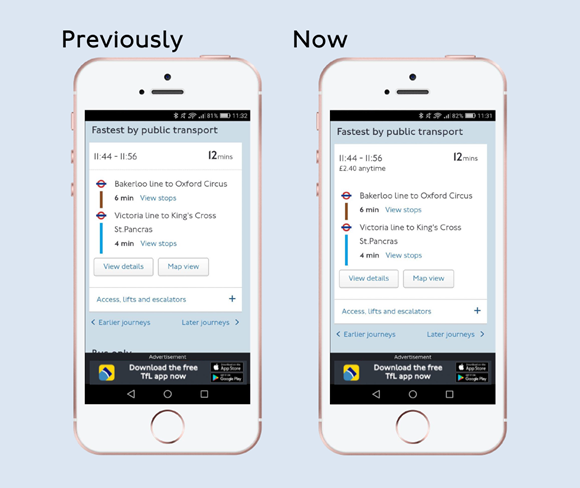
TfL Image 2
Journey planner will also reflect the Mayor’s Hopper fare, which offers unlimited bus and tram journeys within an hour for the price of one – helping to encourage more people to opt for buses to travel around the city. Customers wishing to see fares information, including details of discounted fares and Travelcard options, can still do so using TfL’s single fare finder at tfl.gov.uk/fares
As TfL’s journey planning tool is powered directly from its open data API, the data will also be available to developers free of charge at tfl.gov.uk/open-data and joins an extensive range of TfL data feeds already available. These include live travel information for all TfL services, cycling data and details of planned roadworks and live road incidents. More than 675 mobile phone and online apps are already powered by TfL’s open data, providing up-to-the-minute information and helping millions of people plan their journeys around London each day.
Throughout 2018, TfL will be making further improvements to its journey planner, as well as providing new data to its open data feeds. These include improving walking options within Journey Planner to better highlight when it is the quickest option and better accessibility information across the TfL network.
Ben Gammon, Head of Digital at TfL, said: “This latest update to our ever-growing journey planning tool makes it easier for customers to know the cost of a journey before they travel. By being open and transparent with our data, we can strengthen our relationship with our customers, encouraging more people to use public transport and other more sustainable forms of transport such as walking and cycling.”
As part of its wider work to encourage innovative solutions to London’s pressing problems, TfL has recently launched two challenges for start-ups as part of the Mayor’s Civic Innovation Challenge. The challenges will look for tech start ups to help encourage all people to walk more instead of using polluting forms of transport as well as solutions which can help TfL deliver homes across London, in line with the London Plan. This aligns with the Mayor’s target of 80 per cent of all Londoners’ journeys to be on foot, by cycle or by public transport by 2041.
For more information about TfL’s open data feeds, please visit tfl.gov.uk/open-data
Related Posts

Firecrest Construction Completes 40 Bed Care Home For Exemplar Health Care
Firecrest Construction has successfully completed the complex delivery of a new 40 bed care home in Bury town centre for Exemplar Health Care. As principal contractor to the scheme, Firecrest delivered the job on budget and on time, handing over after 64 weeks...

The Hill Group Achieves Hat Trick of Planning Successes Across the South East
Award-winning housebuilder The Hill Group has secured a hat trick of planning permissions across the South East, marking a significant milestone in the delivery of much-needed new homes across the region. Across three newly approved schemes in Essex, Oxfordshire and...

Hampshire construction firm charts record growth despite industry challenges
Hampshire-based construction firm, PAH Building & Construction, has already secured two thirds of its projected £18 million turnover for 2026, driven mainly by growth in its retrofitting and insurance work. This milestone has been achieved despite wider industry...